
Off-Street Parking Management
Ecological, Smart ve Sustainable Cities
Underground and above-ground multi-story parking lots are important infrastructure projects developed to provide solutions for the increasing number of vehicles and limited land, especially in large cities and crowded areas. Both types have their unique advantages and challenges.
1. Above-Ground Multi-Story Parking Lots
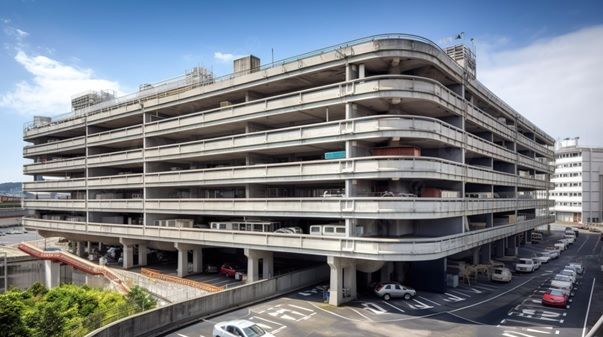
Above-ground multi-story parking lots are parking structures designed as multi-story buildings, generally constructed using reinforced concrete or steel construction.
 Advantages
Faster and Easier Construction: Groundwork and foundation reinforcements are less complex compared to underground parking, which generally means a shorter construction period.
Lower Construction Cost: Due to the simplicity of excavation, underground insulation, water drainage, and ventilation systems, unit costs (per parking space) can be lower than those of underground parking.
Natural Lighting and Ventilation: Since the sides of the floors are generally open or semi-open, natural light and ventilation are utilized, which reduces operating costs (for lighting and ventilation).
Flexibility: Those built with steel construction may offer more flexibility regarding conversion for a different purpose or adding/removing floors in the future.
Disadvantages
Land Occupation and Visual Pollution: It occupies valuable city land and can create visual pollution in the city skyline, especially if there are aesthetic concerns.
Noise: Especially in city centers, noise originating from entry-exit traffic and vehicle maneuvers can cause disturbance to the environment.
Safety (Weather Conditions): Structures that are not completely enclosed may not fully protect vehicles against weather conditions such as snow and rain.
2. Underground Multi-Story Parking Lots (Subterranean Parking)
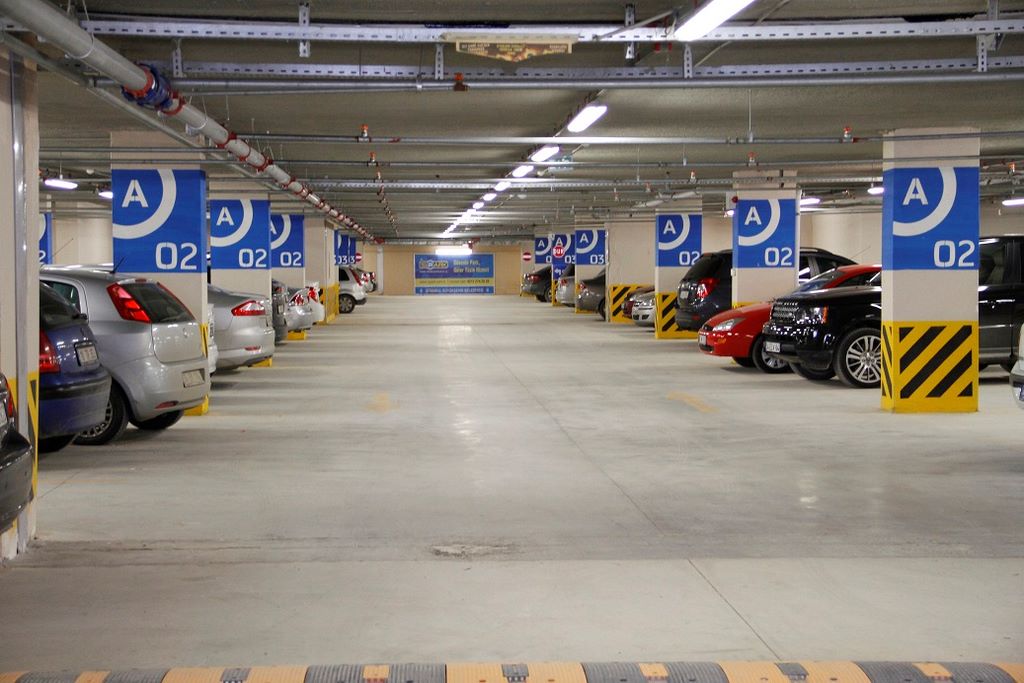
Underground multi-story parking lots are structures built under buildings or public areas (squares, parks, etc.) that remain entirely below ground level.
 Advantages
Optimization of Land Use: Its greatest advantage is ensuring that valuable land above ground (park, square, building, or road) can be used for another purpose. It does not create land occupation.
Visual Aesthetics: It does not disrupt the visual aesthetics of the city and has no negative impact on the skyline.
Low Environmental Impact: Since noise and exhaust emissions are kept underground, their environmental impacts are lower.
Protection from Weather Conditions: It completely protects vehicles from all kinds of weather conditions (rain, snow, hail, excessive sun).
Disadvantages
High Construction Cost: Processes requiring complex engineering such as excavation, ground reinforcement, groundwater isolation (waterproofing), deep foundation works, and tunneling significantly increase the cost.
Long Construction Period: Due to excavation and structural difficulties, the construction period is longer than that of above-ground parking lots.
Operating Cost: The need for artificial lighting and continuously powerful mechanical ventilation systems creates high energy and operating costs.
Safety and Fire Risk: It requires much more advanced and complex fire detection, extinguishing, and smoke evacuation systems against the danger of smoke and fire in an enclosed environment.
Driver Perception: Narrow and enclosed environments can be stressful for some drivers.
Common Basic Design and Technological Features
Both types of parking lots share common features to serve efficiently in modern cities:
Traffic Flow: The slope and width of entry-exit ramps (in accordance with the Parking Regulation) must be designed to accelerate vehicle flow.
Security Systems: CCTV (camera systems), emergency announcement and communication systems, and fire extinguishing systems are mandatory.
Guidance Systems (Smart Parking): Systems that quickly guide drivers with LED indicators showing empty parking spaces and sensors (IPS - Indoor Positioning System) are becoming widespread.
Payment Systems: Mobile payment, automatic passage, and various modern payment options are used.
Lighting: Energy-efficient LED lighting and sensor-based lighting systems are preferred.
Mechanology (Optional): Especially in places with limited space, automatic/mechanical parking systems (puzzle park, multi-story automatic systems) that move vehicles horizontally and vertically can be used.